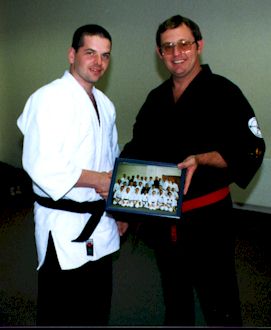
Russell Stutely and Grand Master Rick Moneymaker

Bourne Karate Club has quickly become established as one of the pioneers of Pressure Point Fighting in the UK. We have regularly introduced some of the World's greatest Martial Artists to UK Karateka.
We regularly sponsor seminars on Pressure Points for the World's leading Instructors.
Our intention is to make this knowledge easy to understand, easy to use and to make this knowledge available to all Martial Artists with a desire to learn.
We hope to become the first Karate Club in the UK to be authorised and qualified to teach Torite Jutsu Karate.
All members of the Club are not only instructed in Traditional Shotokan Karate, but also in various complimentary Arts, hitherto hidden in the Kata of this style. Students are also instructed how to incorporate these extra dimensions in their daily Karate techniques, to enhance and develop them further.
Bourne Leisure Centre
Monday 7.30 to 9.30
Saturday 10.30 to 12.30
Over the last twenty years, a considerable amount of
interest has been generated concerning the use of acupoints ("pressure points")
in the martial arts. These include material on medical uses of pressure points (such as
acupressure and shiatsu), as well as their use in fighting techniques. The commercially
available products include seminars, books, videotape and magazine articles; much of it
coming from Europe, Asia, North America and Australia. � The term "pressure point" refers to specific spots along the body,
all of which are highly reactive to stimuli. These are the same points used by
acupuncturists for treating ailments and promoting health. In all, there are 361 classic
acupoints sprinkled across the human anatomy. The martial use of pressure points, however,
refers to controlled strikes to these same acupuncture points. When executed correctly,
pressure point strikes can elicit an array of physiological effects, dependent on the
angle, direction, and force of the strike, as well as the specific point(s) used. Pressure point strikes where originally developed in the Orient. Historical
documentation suggests the martial uses of pressure points were first discovered about
fourteen hundred years ago in feudal China. Over the centuries, these techniques have been
incorporated into several Asian martial arts systems. Under traditional training methods,
these types of "internal" techniques were only given to a student once he or she
reached a certain level of proficiency, discipline and standing within the system. As
such, the body of techniques often refered today as "pressure point strikes," or
by the Chinese term "Dim Mak," were traditionally taught only to the most senior
ranks of students. It was hoped that once a student had attained the proficiency level and
discipline necessary to learn the techniques, he or she should never have to use them. But what exactly is a "pressure point"? Contemporary studies
have led to two schools of thought. The first is based on the "Eastern" model of
Traditional Chinese Medicine (TCM) and Chi disruption. The second is based on western
medical theory and human anatomy. � The TCM model embraces the concept of "internal energy" (called
"Chi") circulating throughout the body along channels, which the ancient Chinese
termed "meridians" and "collaterals." TCM holds Chi as being
dissimilar to nerves, blood and other "observable" biological systems within the
body. Rather, Chi permeates and utilizes them collectively. Within this intricate system,
twelve primary meridians and two primary collaterals connect the internal organs with the
rest of the human body. The areas we refer to as pressure points lie along these meridian
and collateral channels. Many of these points are bi-polar, appearing on both sides of the
body midline (e.g., both arms, legs, etc.) They are distributed from the top of the head
to the bottom of the feet. The Chinese characters for acupoint describe them as
"gate-ways" or "openings" where Chi can be accessed and influenced. In
TCM, each of the classic points has a Chinese name, which in some way describes the
function, location and character of the pressure point. In modern literature, pressure
points have been given a simpler alpha-numeric code. Within the TCM model, strikes to pressure points disrupt the normal flow of Chi
through the meridian / collateral system. This disruption of Chi causes a physiological
reaction within the body. The difficulty with the TCM model, though, is Chi continues to
be a unproven phenomena by Western medical standards. Since the 1970?s, a
considerable amount of research has been conducted in an attempt to prove the existence of
Chi. This has included dissection of tissue, as well as clinical tests using sensitive
medical equipment. In recent years, there have been a significant number of well-regarded
studies that have produced interesting findings favorable to TCM theory. Still, the TCM
model lacks sufficient empirical data to conclusively prove Chi?s existence and role
in acupoint strikes. � Western Medical Theory (WMT) has also proposed a biological explanation for
pressure points, and how they work. Most of these findings originated from broader
clinical studies intended to determine the medical benefits of acupuncture. The most
popular WMT theory centers on nerve or circulatory facilitation to explain why pressure
points work. Within this model, pressure points are places to enter energy into a nerve.
When an individual strikes a pressure point, he or she is sending an electrical charge
down the meridian. Supporters of this neurological model theorize that pressure points are
directly linked with the central nervous system of the body. Specifically, the
neurological model holds that pressure points exist where (i) a nerve ends, (ii) two nerve
fibers cross, or (iii) one nerve fiber branches into a "y." Using sophisticated research equipment, the biological structure of acupoints
has been explored in clinical trials and dissections. The anatomical make-up of the points
has been found to be characteristically rich in certain types of cellular structures,
including free nerve endings and mast cells. In addition, it has been determined that many
pressure points lie directly over proprioceptors; particularly in the areas of the knees
and elbows. Further, pressure points demonstrate high electrical conductivity, which
distinguishes it from surrounding skin. Dissection of the acupoint tissue areas have
produced some, though not complete, correlation. This research has also brought to light
some differences, too. While fairly uniform in diameter (about 2mm), clinical trials have
shown that pressure points range from 0.5 cm to 8 cm below the skin, dependent on their
location. Pressure point anatomy reveals a multi-layered, interconnecting network of
fibers and body tissue, which are not always uniform of consistent from point to point.
But amid these differences, certain regularities exist too: (A) Electrically, pressure points conduct current better than other
areas of the body. This conductivity is fairly uniform and consistent, and has been
clinically proven on test subjects, as well as cadavors. These tests suggest a uniform
cellular quality exist in pressure points. (B) Chemically, there are measurable differences in sodium and potassium
in acupoint cells, as compared to surrounding tissue. It is thought these higher levels
contribute to the conductivity of the cell areas. (C) Histologically, there are some specific cellular structures common
to pressure points, which appear in patterns different from surrounding tissue. These
include high concentration of capillaries, mast cells, lymphatic drainage, and sensory
afferent nerves. (D) Anatomically, almost all pressure points lie along folds in tissue
groups and connective fibers. Of interest, in the area of the human body with the highest
concentration of nerve fibers (the derier), there are the fewest acupoints. Without question, there is a considerable amount of credible scientific work to
support the existence of pressure points; this is undisputed. But the exact nature of the
points and their ability to effect the body remains a bit of an enigma. To date, no model
has been proposed which satisfactorily explains all facets of these elusive regions.
Still, new studies continue to pioneer and build on what we know about pressure points,
and why strikes to the points are so effective. Continually, these studies produce new
findings which challenge what we know, and spark our creativity to find certain answers.
Collectively, it continues to expand our knowledge of the martial arts and medicine. In
time, the answers will surely come.
Latest update Dragon Society unite with B.C.A. click here to learn more
Bourne Karate Club
Russell Doing a Knock Out using an X-Block
TIMETABLE
Training times are as follows:



 Main Page