Aikido en el Norte
Aikido
Contenido/Contents
 Aikido Basauri
Las Fotos/Photos
Aikido Basauri
Las Fotos/Photos
Cursos y Seminarios/CoursesTecnicas/Techniques
Diccionario/DictionaryPressure Points & Dragon Society International
Salud/Health and Fitness
El fundador de Aikido y Fotos/O'Sensei and PhotosAIKIDO
Abajo tu puedes firmar nuestro libro de visitantes,Gracias!/GuestBook

�Qu� tiene el Aikido de diferente?
No hay combate,no existe adversidad entre los practicantes.Su espir�rtu va m�s all� de lo deportivo y elimina el �nimo de competici�n.De ah� la idea enga�osa que da este arte al desconocedor de su t�cnica y desarrollo.
�A qu� personas va dirigido?
La forma de no violencia que practica el Aikido,que es considerado como el arte marcial m�s puro en cuanto al significado del Budo,influye considerablemente a la formaci�n de todas las personas.Forjando una personalidad definida,con una conducta tranquila,huyendo de las disputas si las encuentra y Nunca Provoc�ndolas.
�Y las mujeres....?
Conviene precisar que la mujer puede practicar Aikido sin Ningun restricci�n.Sus ejercicios le producen una mayor esbeltez corporal y mejora la armon�a fisiol�gica que act�a beneficiosamente sobre su psique,d�ndole confianza personal.
El Aikido no es masculino ni femino y no deberia existir ninguna actitud previa respecto a c�mo deber�an actuar o practicar el arte,los hombres o las mujeres.
�y para sirve todo esto en nuestros d�as?
Esta formaci�n,que a primera vista no aparece tener importancia,va a conseguir en un alto porcentaje de casos,evitar las crisis de ansiedad,de angustia y los llamados "Stress" de nuestro Tiempo.
"Quiero que la gente escuche la voz del Aikido.No es para
corregir a los otros,es para corregir tu propio cuerpo y
mente.Eso es Aikido.Esa el la misi�n del Aikido y debe ser
Tambi�n la tuya".
O'Sensei Morihei Ueshiba
(1883 - 1969 )AIKIDO
AI-KI-DO: �Qu� Significa?;La traducci�n de estos vocablos Japoneses puede ser:"La V�a para la union de cuerpo y esp�ritu"� "Camino de la armon�a espiritual"� "M�todo para conseguir la uni�n con la energ�a vital".
Tecnicas de Relajaci�n y Tension Nerviosa.......
Respiraci�nNormalmente cuando una persona esta nerviosa o tiene estr�s pueden tener a menudo "perdida de aliento".Como cuando ocurre un incidente y respiramos entrecortadamente,� como cuando estamos haciendo un examen o si estas preocupado por una entrevista que vas a tener Ma�ana,este tipo de cosas puede afectar tu salud a la larga.
Lo primero que te sugiero que hagas es,Tomar 10 profundas inspiraciones por la Ma�ana antes de que empiezes un ejercicio � tu jornada Laboral etc.Las inspiraciones has de hacerlas desde tu est�mago y no desde tu pecho,que es como lo hacemos cuando estamos nerviosos.Pon tus manos sobre tu estomago y siente como se hunde,cuando la �ltima pizca de aire haya dejado tus pulmones,repitelo 10 veces y as� reforzar�s tus pulmones y abriras las V�lbulas de aire.
Si acostumbras a respirar correctamente,nunca tendr�s problemas reconociendo los s�ntomas de respiraci�n entrecortada.
Relajaci�n Muscular.
T�s Musculos pueden salir perjudicados debido a la tensi�n,llegando a sentir el dolor,en ciertos partes y pudiendo acarrear dolores de cabeza,Por ejemplo,cierra tu mano y aprieta tu pu�o hasta que no puedas apretar m�s.Espera 10segundos y rel�jala,intenta imaginar lo mismo con el resto de los musculos de tu cuerpo.Cuando hayas acabado con tu mano dale un masaje y sacudir todos las vibraciones Negativas.
Puntos de presi�n
Este es el complicado,pero sin lugar a duda el m�todo mas efectivo para combatir el estr�s � cualquier sentimiente de disconformidad en tu cuerpo.Normalmente tu energia se considera poco equilibrada cuando corre muy alta � baja.Esta es la causa de la mayoria de los problemas
Cojamos por ejemplo Ht 7,�ste se usa por ejemplo cuando hay estr�s en el cuerpo � cuando el Coraz�n empieza a ir rapido,masajeando �ste area durante 15 segundos,3 veces al dia reducir� el mal sentimiento de tu cuerpo.Un buen punto tambi�n es el Pc4, presiona ligeramente aqu� y en la direcci�n de tus dedos. El Gv14 es un punto excelente para alguien que se sienta un poco cansado, tambien se puede poner algo fr�o o caliente para calmarlo.
Comida
Mucha gente se sorprende cuando se les dice que ciertas comidas pueden provocar mal estar general o falta de energ�a. Alimentos como el quesso, chocolate o caf� pueden acarrear dolores de cabeza. La leche no es buena para gente que padece de asma, ya que puede dar dolores en el pecho etc. Pero por otro lado la leche es rica en calcio, por lo tanto buena para los huesos. El consumo de carne roja en grandes cantidades puede acarrear tristeza depresi�n y cansancio. �Qui�n no se ha sentido como con cansancio y pesadez despu�s de una comida muy abundante? Esto se debe a que no has distribuido suficiente energ�a entre tu sistema digestivo y tu sistema activo externo, y la comida no hace mas que buscar una salida, el simple hecho de ir a dar un vuelta puede ser una buena forma de evitar sentirte tan lleno, otra soluci�n puede ser la de comer chicle.
Jason Kenny 98'
'Alan Ruddock Sensei. "A journey through the Arts".
As a young 13 year old Dubliner Alan Ruddock began a journey through the Martial Arts that would eventually lead to him spending several years training in Japan under Morihei Ueshiba (the founder of Aikido). - An honour shared by no other Irishman.
His contact with the Arts began when he joined an Irish Judo Association club in Parkgate Street under Seamus Kavanagh (then 2nd Dan). This initial training in Judo, coupled with some Ju Jitsu and Unarmed combat, led Ruddock to his first brush with Aikido.
[RC] What was the public perception of the Arts in those pre Hollywood / Bruce Lee days?
[AR]"In the early 60's Judo was thought of as somewhat magical art - a means for the little guy to triumph. Karate was virtually unknown and Aikido was even more obscure - really Far Out. " By 1960 Alan had moved over to Karate and started to attend courses run by the British Karate Federation.
"I began to attend course in England run by the British Karate Federation. I started and ran the first Shotokan dojo in Ireland in the early sixties in an old training hall near the Inchicore C.I.E. works. I was also training myself from Karate books.
The B.K.F. instructor was Tetsugi Murakami 5th Dan who was based in Paris and was a protege of Moshizuki Sensei's Yoseikan Aikido School in Japan. Murakami Sensei taught a Shotokan style of Karate and a little Aikido. Murakami Sensei visited Dublin several times. Students at that time included many of my personal friends such as Michael O Doherty, John Robinson, John Langley, Richard Murphy - and quite a few of the Judo boys from Parkgate Street - including the bold Anto Clark. I was designated Japan Karate Association representative for Ireland around that time.
My first real experience of Aikido techniques was with Murakami Sensei. His use of 'something else' in his freestyle Kumite sessions and his occasional lesson in Yoseikan style Aikido - really put me onto the Aikido trail."
[RC] At what point did your focus shift completely to Aikido?
[AR] In 1964 I decided to go to Japan to learn Aikido - I had been in the Merchant Navy as a radio operator for two years and knew of the existence of the Aikikai Hombo Dojo through Tohei Sensei's Book- Aikido. When my ship visited Yokohama I high tailed it to the dojo....... I met Henry Kono on the afternoon of that visit and I stayed to watch the evening class. Whilst I did not see Morihei Ueshiba (O-Sensei ) on that occasion - I did get to see some other Sensei including Saotome. I also met Ken Cottier and Fred Wainwright who had gone to Japan to see the 1964 Olympic Judo - arrived too late and decided to stay and study Aikido. I resolved to go home and earn enough money ( as a security guard ) and return to study Aikido full time. During that year I discovered Ken Williams Aikido Association in England and attended the 1964 Summer School with Nakazono Sensei 7th Dan.
The first time I actually trained in Tokyo was on my return in early 1965 when I began training at the Hombo Dojo in Shinjuku. It was just straight into the regular class, one technique after another, no instruction on basic Taisabaki (body-movement) or Ukemi (Breakfalls) from the Sensei.
At first I did not know what hit me - the mats were rock hard, rough, canvas covered Tatami, in dire need of renewal. They tore the skin off my feet and it took a month or two before the required callouses could build up. It took real determination for me to stick out those initial months.
The first time I actually saw O Sensei was about three or four days after I started regular training. He came into the class, gave a short lecture and threw one of the Uchi-deshi (live-in students) around. I knew what he did was special and wanted to be like that too - but I did not feel the same 'Wow - this is something else!" kind of response that others report. I was impressed and intrigued - but not overawed. My journey to Japan was a personal spiritual quest and I realised that this man was someone you only get to be around once - he was a true mystic.
Over the coming months and years I was to see him on a daily basis (when he was in Tokyo). As a karate man with both Judo and Jujitsu experience, I was not easily impressed by people flying through the air for apparently no reason. I had made a huge effort to be there to learn what was on offer but - initially I thought - 'Can this really be true, these guys are just falling over...' Then, little by little, as other guys who had 'gone for him' described their bewildering experiences of falling ( for no good reason ) and my own careful observations of the Ukes - I was convinced that this man was incredible. O-Sensei gave to anyone who was open but he was also a man apart - even from the Japanese. You 'got it' by being there and doing the business - not by special treatment. In fact working it out for yourself was par for the course.
[RC] Is there some special occasion that you have particularly fond memories of?
[AR] When we (the Gaijin Group) went to the dojo to bring O Sensei a birthday cake - that was a very special occasion. First we has a formal photo with O Sensei in front of the dojo shrine, then we went into O Sensei's adjoining house. O Sensei sat on a sofa eating his cream birthday cake with a spoon, he supped beer and smoked and smiled - with his false teeth in. Before long Henry was questioning him about Aikido at which stage he got up and started doing Irimi-nage on Terry Dobson right there in the room.
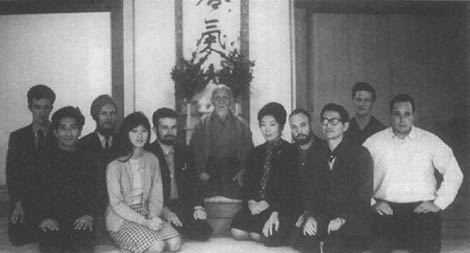
Group at O'Sensei Birthday(Alan Ruddock on the Far left and Henry Kono in the the front,Terry Dobson can also be seen on the far right.
O Sensei often watched what was going on from the small office overlooking the dojo. He would step out and admonish anything he didn't like, which sometimes happened during my private lessons with one of the Senseis. He would come out if he thought I was getting a raw deal and say - "Don't you throw him round like that!" Other times he would stroll into the dojo and lecture for a few minutes on the philosophy of Aikido - based on the ancient Japanese chronicle The KOJIKI. Then he would use the Uchi-deshi present to demonstrate Sokumen Kokyo Nage or Irimi Nage - these were his favourites. Occasionally he would invite one of the Dan grades to leap up and attack him . These were usually the most spectacular moments - the attackers feet would appear to lift off the floor and the Uke would travel horizontally forwards & down into the mat.
[RC] How regularly did you train?
[AR] Every day, seven day a week. Sometime I even went to train at Nishio Sensei's Otsuka Dojo as well. Nishio Sensei (7th Dan Aikido, 6th Dan Iai and 5th Dan Karate) taught in several dojos around Tokyo. As an ex-karate man I loved his Aikido - so dynamic and full of moves which cross-referenced all of his arts. He always included some live blade defence work in his demonstration of Aikido.Taking Ukemi from Nishio Sensei was exciting - he did quite a few full body throw and would throw you right through the floor of the Otsuka Dojo - which fortunately was well sprung. O Sensei had a particular admiration for Nishio Sensei.
Alan spent from 1965 to 1968 in Japan then, after a while in Hong Kong helping Virginia Mayhem run the Hong Kong Aikikai, he eventually returned to Ireland and set up a small Aikido club. "The Aikido group around 1969 involved some of the survivors of the earlier Karate group, including Michael O Doherty, John Robinson and John Kearney. Unfortunately I had to leave soon after to find work in London. I had no contact with Chiba Sensei when I was living there ( intentionally) but did run a small Aikido club in College (attached to London University ). In 1974 I took up work in the Isle of Man and have run an Aikido group there since 1975.
The Branchings of Aikido
(This has been written By Aikiko Nagase and has been translated by her into English,there maybe a few extra bits of Information for those wishing to know about the story of Aikido)
There was the list of some styles of Aiki-do. I think you can't read it as it was all written in Japanese, but it is on this page : Aikido styles There were 5 groups on the list.
AIKI KAI
It was made by the son of Morihei Ueshiba, Kissyomaru. AIKI KAI is the only organization that was admitted by Japanese Ministry of Education and has the Japan wide organization. 90% of Aiki-do is under this organization. As an outer organization there are ZEN NIPPON AIKIDO RENMEI (All Japan Aikido League), ZENKOKU GAKUSEI AIKIDO RENMEI (All Japan Students Aikido League), and in 1975 KOKUSAI AIKIDO RENMEI (International Aikido League) was founded and it is now in over 60 countries.
ZENNIPPON AIKIDO KYOKAI
It was founded by the student of Morihei Ueshiba, Kenji Tomiki in 1966. It is unique for doing 'Ran dori' and it is in some oversea countries like England, the US, and Australia.
YOUSHIN KAI
It was founded by a student of Morihei Ueshiba, Kozo Shioda in 1955. This organization teaches the technique that Morihei Takeshiva mastered before the war. It has some branches in Japan for example Japanese Police Ministry and there is also oversea organization in Canada.
KI NO KENKYU KAI
It was founded by Koichi Fujihira who was the main trainer of AIKI KAI in 1974 as the independent organization from AIKI KAI. It is called Shinshin Toitsu Aikido too and there are some branched in Japan and overseas.
AIKIDO SA
It was created by Fumio Sakurai who was the ex-trainer of YOSHINKAN. It is made by organizing Aiki Jyujitsu, Aiki Goshin, Aiki Kumite. It has some communication with some other martial arts. It has some unique rules.AIKI KAI seems to be a very big world wide organization and it has its English home page at this address : Aiki Kai
Aikido en Basauri
Las Fotos
Para ver las Fotos pulsar aqui
Cursos y Seminarios
El Fundador de Aikido y Fotos

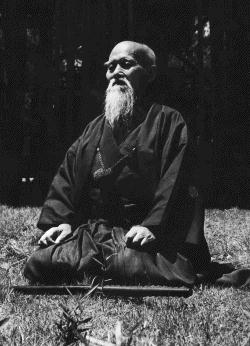
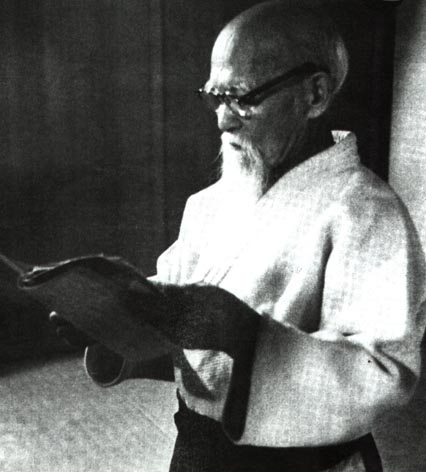
Morihei Ueshiba
Nacio en Noviembre de 1.883 en Tanabe,provincia de Kii(prefectura de Wakayama)al sur de la pricincipal isla Japonesa.A los 18 a�os comenz� sus estudios de Jujitsu(escuela kito)en la ciudad de Tokio.
De regreso a su pueblo y tras superar una larga enfermedad,decidio estudiar esgrima en la escuela Yagyu.
Tras terminar el servicio militar estudio Judo con el Maestro Kiyoichi Takagi y se convierte en habil jinete,cabalgando por las monta�as y praderas de la provincia de Kitami.
Con 28 a�os ingresa en la escuela Daito de Jujitsu,con el Maestro Sokaku Takeda,corria el a�o 1.911;en 1.916 recibe el diploma certificado de su dominio en todos los estudios de esta escuela.
En el a�o 1.919 establece su primer encuentro con el Rudo Wanisaburo Deguchi,fundador de la religion Omotokyo,en Ayabe,prefectura de Kyuto. Un a�o m�s tarde,tras la muerte de su padre,vuelve a Ayabe con toda su familia,donde estabelce su hogar y estudia silenciosamente hasta el a�o 1.926.
Resumiendo un poco m�s
Desde joven se interes� por el Budo;poco a poco fue ganado en habilidad tras su peregrinaje por el mundo del Jujitsu se convirtio en devoto de la esgrima y del estudio de las religiones.Al Budo que obtuvo atrav�s de todas sus experinecias,en todos esos a�os,le dio el nombre de AIKIDO.
"Aiki-do"
It is said to have originally come from DAITORYU AIKI-JYUJITSU. DAITORYU AIKI-JYUJITSU was handed down by the Kai Takedas and it was to have been introduced to Aizu and it was handed down to a part of high-ranked Bushi as the martial art that would never be allowed to be taught. But DAITORYU AIKI-JYUJITSU was too sophisticated for the technique of this era, and this story has many questions. AIKIDO was created by Morihei Ueshiba(1883-1969), who has no relationship with the Takedas. He mastered KITOURYU JYUJITSU, KYOSHINMEICHIRYU SININRYU KENJYUTSU and then he joined the armed force. There he learnt JYU-KEN JITSU and after retirement he mastered GOTORYU RYUSEI JYUJITSU. Some years after that he met Sokaku Takeda who was handed down DAITORYU AIKI-JYUJITSU and after training he received the secret of it. At the same time he mastered YUSAI and KENSAI (it is kind of Shintoism) and got the reason of KOTODAMA. Morihei Ueshiba created the form and technique of Aiki-do based on those things. In the spiritual aspect he founded the new martial art that took the concept of "Ki" from the teachings of Shintoism. This is Aiki-Jyujitsu. Aiki-Jyujitsu changed its name to SOUBURYU, KOUBUKAI AIKIRYU JYUJITSU, KOUBUDOU, DAINIHONBUDO, and in the year 1942 it became AIKIDO."


Please Sign the Guestbook
View the Guestbook
 This page was last updated : 26/5/99 by "Jason Kenny"
[email protected]
Tambien aqui puedes mandar tus mensages:
Jason Kenny
This page was last updated : 26/5/99 by "Jason Kenny"
[email protected]
Tambien aqui puedes mandar tus mensages:
Jason Kenny